Thursday, December 16, 2010

A veritable Babel

[This is a very long post, but I hope an interesting one!]

West Africa is not like the USA or Australia or even Latin America for many reasons, but one is easy not to think about until you get here. Ghana is English-speaking, says the guidebook. Senegal, French.

Ha!

Virtually no one here speaks a European language in the home. And because of the long history of migrations within the continent, in any given location there are at least 3 or 4 African languages that are the first language of a large segment of the population. The language you speak at home is, as far as I can tell, the primary indicator of what tribe/clan/people you belong to.

But you also don’t just speak your in-the-home language plus English/French. Usually, you speak your own language, plus at least one other African language that is widespread in your area at the level of fluency, plus at least one other African language as well as I speak Spanish (which is to say, plenty well enough for daily practicalities, bargaining, etc). So for example, in the Gambia, the languages/tribes that are widespread include Wolof, Mandinka, Fula, and Sarahule. Of these, most people seem to have practical knowledge if not fluency in both Wolof and Mandinka, as well as their own language if it’s neither of those

You also probably went to Koranic school and memorized the entire Koran in Arabic as a child, and if you are particularly religious you may have learned even more Arabic than that or at least kept up your Koranic reading over the years. And then, if you went to school, you speak either English or French (possibly both) reasonably well (and if you didn’t, you probably speak enough to at least sell things to tourists). And none of these languages are luxuries – you need all of them to conduct your daily affairs. Pictured is Malang, an 18-year-old member of Ibraheem's household, who speaks Mandinka, Wolof, Fula, English, and French, in front of an Arabic-language TV program.

It’s enough to give me, with my practical Spanish and my beginner-level dabbling in German, Mandarin, and French, quite the inferiority complex. And it really puts Americans to shame in general. Imagine how much better off we’d be if every American spoke both English and Spanish fluently, as well as at least one other language at a proficient level! And we’d still be behind West Africans. [It also seems like quite the waste of brainpower here in an objective sense. Part of me feels like “gosh, if they’d just all speak English at home and then devote all that energy and time to learning Mandarin, Arabic, and either French, German or Spanish, they’d have valuable skills marketable the world over!” But of course that is not how it works…]

Other observations:
  • Most people are not literate in any African language, with the exception I think being Wolof in Senegal, in which there is actually a growing body of literature, film, etc (though there is both Wolof written in the Roman script and Wolof written in Arabic script, called Wolofal). Even in Senegal, though all the Roman script writing I saw on signs/shopfronts/etc was in English, and I assume that all the Arabic script writing was in Arabic, not Wolofal.
  • The two families who have so graciously hosted me both have televisions in the parlor that are on a lot of the time, and almost all the programming is in English. Watching cartoons takes on a whole educational level if you are learning a language while watching!
  • I think I’ve gotten a lot better over the past 5 weeks at parsing English spoken with a West African accent. The big problem I have is not so much the different pronunciation of vowels and consonants, though there is a bit of that, but more the difference in emphasis on syllables and the rhythm of the sentence. Eg, the word “development”, which is used a lot here, is pronounced something like dee-VEL-up-MUNT by us, and something like "DUH-vlup-munt" by most West Africans I’ve encountered. String a bunch of differently-emphasized words like that together and change the emphasis/rhythm of words within the sentence, and it can be really tough for the American ear to parse.

There are a few concepts/types of communication that routinely cause problems for me:
  1. Relatives: The words “brother”, “sister”, “father”, “mother”, and so on, are used to refer not just to your immediate nuclear family, but to your cousins, aunts, and uncles – because in West African family structure, your father’s brother has equivalent authority over you as your father, and your responsibilities to his children are not that different from your responsibilities to your father’s children. It took me a while to break the reflex of assuming that when someone uses one of these words, they mean what we mean. There are other confusions like using “stepfather” to refer to your father’s brother (because if your father dies, he will probably marry your mother), and “uncle” to refer to the unrelated man your mother marries after your father’s death (I don’t know why – I guess because “stepfather” was taken and “uncle” wasn’t being used?)

    Moreover, it’s clearly not just a translation issue – it’s a different way of categorizing the world. When I ask something like “what is her relation to you *actually*? How are her parents related to yours?” etc – people have to actually think about it as if solving a new math problem. Their relatives are classified in swathes of “grandparents” (people two generations above you) “fathers/mothers” (people one generation above you), “sisters/brothers” (your own generation), and “sons/daughters” (the generation below), and the question that Europeans consider critical of what percentage of your genes you share is simply not relevant.

    What I am dying to know but can’t figure out how to get across the concept of asking is at what point the expansion of kinship ends. If your father’s brother’s children are also your brothers and sisters, then they are your children’s fathers and sisters as well. But clearly that can’t go on forever – how and when does someone drop out of that category and just because a loosely defined “distant relation”, which they also do talk about?


  2. Referents/pronouns: First, I am often confused by stories in which gender pronouns are used because either the pairs he/she and him/her are used interchangeably or else my ears can’t hear the distinction within a West African accent.

    Second, compounding the problem, I have a very difficult time making a question like “but I’m confused, who is the “he” you are referring to in this story?” clear. For instance if out of the blue someone says to me “You know, that woman owns the store down the road,” and I ask “who is that woman?” because I don’t know who they’re referring to (the woman we just greeted on the roadside? The woman we had an appointment with earlier today? The mother of a friend who we were just talking about?”), The answer is usually “The woman who owns the store down the road.” I repeat, yes, but who are you talking about? The frustrated response: “The owner of the store! I hope you understand now.” And so on…


  3. Planning/time. This one I assume is only partly language, and a lot about the whole “African time” phenomenon. But questions like “how soon will he get here?” are often answered with statements like “he has already left.” “But how soon do you think that means he will arrive?” “Oh, that I cannot say…”


  4. Measuring frequency & ratios. (I think this is probably related to the African time phenomenon as well.) Being my father’s daughter a lot of my questions about culture and lifestyle come in the form of “How often do you do X?” or “What percentage of people are Y?” The answer to a question like this almost invariably comes in the form of an anecdote, about a time when they did X or a person who is Y. The anecdotes are usually very illuminating about how things work, but they do not answer my question!

    In order to get a related answer, I have to repeat the question in several different but related ways (eg, “When was the last time you did X? or “How many times did you do X last month”? or “Are most of your friends Y, or just a few?”), and even then often fail. I have been thinking that I should actually try this on some random Americans and see how it goes – it seems entirely possible that my set of friends and colleagues think about frequencies and ratios differently from the average Anglo as well from the average African.

Home in less than a week!


Have been busy the last few days, not as much blog posting time, but much to blog about... This trip is very rapidly coming to a close – I fly back to Accra on Saturday, then arrive in DC on Tuesday morning, then fly to Greencastle on Wednesday evening, if all the flights go as scheduled.

I really don’t want to think about what the temperature shock is going to feel like… I don’t even have a jacket in which to make my way from Dulles to Mt Pleasant!

On the other hand, Kalila is by all reports doing quite well at the Indianapolis hospital post-surgery, and I’m really looking forward to checking up on her in person very soon.

Speaking of kids, here’s a bonus picture of me carrying Bobo (Ibraheem Jr) around on my back, African-style. The Gambians Sirah and I walked past on the street found this hilarious. It’s also the first practical use for large breasts I’ve ever recognized – they’re essential for fighting the baby’s gravity!

Monday, December 13, 2010

Sandele Eco-Resort


This post is primarily for some friends who are considering Sandele as a retreat site. I have no other easy way of sending photos to them :-)

Going clockwise from top right:
First pic -- view from beachside meeting hut
Second pic -- view of inside of beach meeting hut
Third pic -- view of unfinished inside of another meeting space -- they are planning to remove some of the pillars
Fourth pic -- view of rooftop meeting space. Right now there's no roof but they say they can easily construct a shade tent.

Down South


Today, Sarjoe and I headed down “south” (insofar as the Gambia has a “south”) along the coast -- all the way to the Gambia's southern border with the Casamance region of Senegal. The border river (pictured, with Sarjoe) and the beaches in the Kartong area were both beautiful, serene and almost unoccupied.

Working our way back north, we stopped to see (and hold!) the snakes at the local Reptile Center. The woman who gave us a tour said that there are serious misconceptions about snakes in Gambian folklore that can even lead to unnecessary deaths, so part of their mission is to teach several thousand Gambian schoolchildren per year what there really is to fear and not fear from the local snakes. Unrelatedly (I hope), she had a simultaneously understated and lewd sense of humor -- telling us about one kind of snake that allegedly has two penises and can go at it for 24 hour straight; cracking jokes about tortoise polygamy; and ending the tour with the question "What is the most dangerous snake in the Gambia?" with the unexpected response "The one in men's pants."

At around 5pm, we watched the fishing village Tanji in full swing, with boatloads of fish pulling up and a sophisticated ladder of distribution in deployment. From what I could tell, it works something like this: Wholesale brokers take their teams of teenage boys out to the boats, buy fish in bulk, and have them carried back to shore in enormous buckets. Those fish that are to be dried are then carted away from shore in wheelbarrows to the smokehouses just a few dozen meters away. The fish that are to be sold fresh, iced or salted are bought on the beach from the wholesalers by small-scale distributors on the shore, who then take them to market in Serekunda or wherever the next day (presumably) -- or possibly resell them to the people who are actually going to take them to market, taking their own small slice of profit at each step of distribution.

Also today: We had lunch at and a very interesting briefing on the stunning Sandele Eco-resort, which we were checking out on behalf of Avaaz as a possible retreat venue. We also went to the Tanji museum on the history, culture, flora and fauna of the Gambia. And we visited with Sarjoe's sister and his former boss (a retired UNICEF professional).

Sunday, December 12, 2010

The Sunday rounds


Yesterday, Sirah, Rugi, Bobo (Ibraheem Jr) and I did the rounds of family visits around town. First we visited Ibraheem's family compound, then Sirah's family's compound. The first picture is of the children at the latter compound eating in the standard Senegambian fashion -- a big bowl of rice with some form of flavorful stew/curry mixed in, eaten out of collectively with one's hands. The children, women, and men each eat out of separate bowls (you graduate to the adult world when you're about 10).

[That brings me briefly to the topic of hygiene and disease: There seems no concern or really even awareness of non-fatal person-to-person communicable diseases like colds or the flu -- but I also haven't heard of anyone having one. It's considered an absolute given that all food and drinks are shared in a way that would make most American parents shudder for fear of their child having the sniffles for a few days. Hands are also washed pre-meal in shared bowls of water, which doesn't really help the situation much!]

Next came Rugi's father's compound (where his second wife lives -- his first wife lives in Sirah's family's compound), and finally the house of one of Sirah's cousins, her husband, and his second wife. Sirah's cousin gave birth 2 weeks ago to her 4th child, who I think may hold the distinction of the youngest child I can remember ever holding. The second picture is of Rugi's father writing Koran verses (using washable ink) in Arabic for the children in his compound to memorize. Rugi herself goes there after school most days to learn them.

These compounds are all literally crawling with children. I'd say the adult-to-child ratio is about 3:2 if you define child as under 16 -- which fits approximately with the published demographics of the Gambia. But the childcare burden for adults is no more overwhelming than it is in the US, possibly less so, because first of all of the shared load among all the women and second because of the extremely well-established role that the older children (especially but not exclusively the girls) play in caring for the younger children. In fact, it's led me to think a lot about the way that we think about education. I may be able to type and read really fast but any 10-year-old Gambian girl is far more qualified to care for a child than I am -- and you can't say that's not an important life skill!

Afterwards we went to the beach again for a little while -- hence the final photo. Rugi is developing quite an impressive flick, no mean feat in the windy oceanside conditions especially

Ile de Goree


Another post to catch you all up on my time in Senegal:

I spent a day on Ile de Goree, a tiny picturesque island just off the Dakar harbor with about 2000 permanent residents, most of whom are small-scale innkeepers during the tourist season and many of whom are artists of one form or another. It was one of the initial strongholds of the Europeans in Senegambia and served as a key administrative base for hundreds of years for several European powers (the Dutch, the Portuguese, and the French all had their turns) as well as a holding center for slaves waiting to be shipped to the New World.

The historical museums were interesting (and provided a reason to discover that with my Spanish, English, and very rudimentary spoken French, I can read French reasonably well -- I'd say better and faster than most West Africans I've met can read English, even those who've been all the way through secondary school), the art was quite good, and being in a place so central to such a horrific phenomenon as the slave trade is of course sobering at best. But what I actually enjoyed most about the island was finding the "hidden" corners of the island where the villagers were just living their lives with only the occasional observation of tourists.

The second picture is of a group of girls playing a game that seemed vaguely familiar to me -- I think that in elementary school I might have played something similar. They had a long elastic band that three of them stood in the corners of to form a triangle. Three others stood inside the triangle, one on each side, and then in synchronized fashion jumped over the band on their side, jumped back over, and moved to the next side.

I watched for a while (not daring to get too close and distract them), but couldn't figure out what the rules were for when you got kicked out of the jumpers. You were definitely allowed to touch the elastic; the height wasn't being consistently raised or anything, but there was clearly something you could do wrong that would result in your turn being over -- and I couldn't figure out what it was. Ah well, another one of the humbling mysteries of life, reminding us that not everything is knowable...

Kalila update: Ready for surgery!


I'm in the Gambia while Kalila, her parents, and my mom are getting ready for surgery!

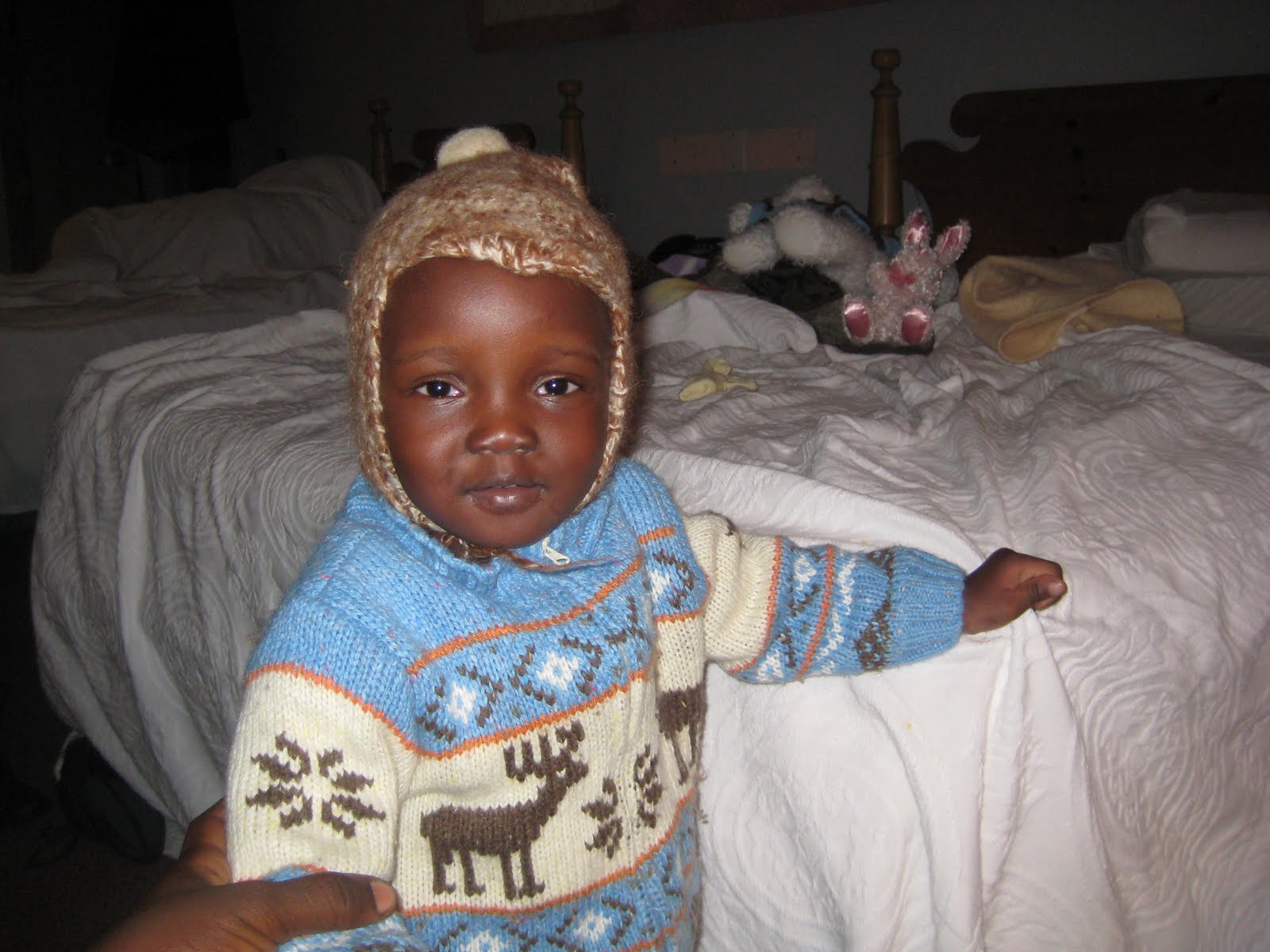
The email my mom sent to all donors yesterday -- with a cute photo of Kalila in her donated sweater and hat to ward off the Indiana chill!

***************

Dear Friends,

Kalila and her parents, Faiza and Samar, arrived Thursday morning. We went straight to the hospital for a full day of tests. I had predicted that Kalila would be scared and miserable. Not at all! She (unlike her parents) had slept well on the night flight from Ghana and seemed totally delighted to find herself in a brand new place to explore. Despite the fact that she was being pricked and prodded by strangers the entire day, she was charming and cooperative. The best day-long performance I can ever recall for a two-year-old. I can see why Taren fell in love with her.

Unless catches a cold, her surgery will be first thing Monday morning and should last 6 - 7 hours. Please keep her and her parents in your thoughts and prayers. Her parents have expressed their gratitude to all of you many times over.

Kelsey